
The Consistency Tax: Why brand fragmentation is costing you more than you think
Every high-growth business reaches a point where the scrappy, improvised approach that got them to £10 million starts working against them. Sales decks multiply. Marketing experiments fragment the message. New hires join without context. Partners interpret the brand differently.
The result? A hidden drag on performance that rarely shows up in board reports but quietly compounds quarter after quarter.
Call it the consistency tax.
The numbers behind the problem
Research from Lucidpress and Demand Metric found that companies maintaining consistent brand presentation across all platforms increase revenue by 23-33%. That's not a marginal gain. It's the difference between steady growth and stagnation.
Flip that finding around and the implications become stark: inconsistent brands are leaving nearly a quarter of potential revenue on the table. Every quarter. Year after year.
The compounding effects go beyond top-line revenue:
Inconsistent brands need 1.75x more media spend to achieve the same results as their consistent competitors (Amra and Elma, 2025)
Brands with high consumer awareness achieve 2.5x the conversion rates of low-awareness competitors across all channels (Nielsen, 2024). Consistency builds that awareness over time.
68% of businesses report 10-20% revenue growth directly from brand consistency initiatives (Lucidpress, 2021)
Meanwhile, customer acquisition costs continue to climb. In SaaS, the median CAC ratio rose 14% in 2024 alone. While that figure is sector-specific, the broader trend of rising acquisition costs makes efficiency gains from brand investment increasingly valuable across industries.
Why high-growth businesses are particularly vulnerable
The consistency tax hits scaling businesses hardest precisely because growth amplifies fragmentation.
In the early days, everyone knows the story. The founding team carries the brand in their heads. Decisions get made quickly because context is shared. But as the organisation grows, that implicit understanding doesn't scale.
New team members arrive without the founding context. Different departments develop their own versions of the pitch. Regional teams adapt messaging for local markets without a clear framework. Agency partners fill in the gaps with their own interpretations.
None of this happens through negligence. It happens because growth demands speed, and speed often outpaces coordination.
The gap between understanding, coherence, documentation and implementation is where the consistency tax accumulates.
The real cost isn't creative, it's commercial
Brand consistency is often framed as a creative concern - logos, colours, tone of voice. Important, certainly, but not where the real cost lies. The commercial impact shows up in places that rarely get attributed to brand:
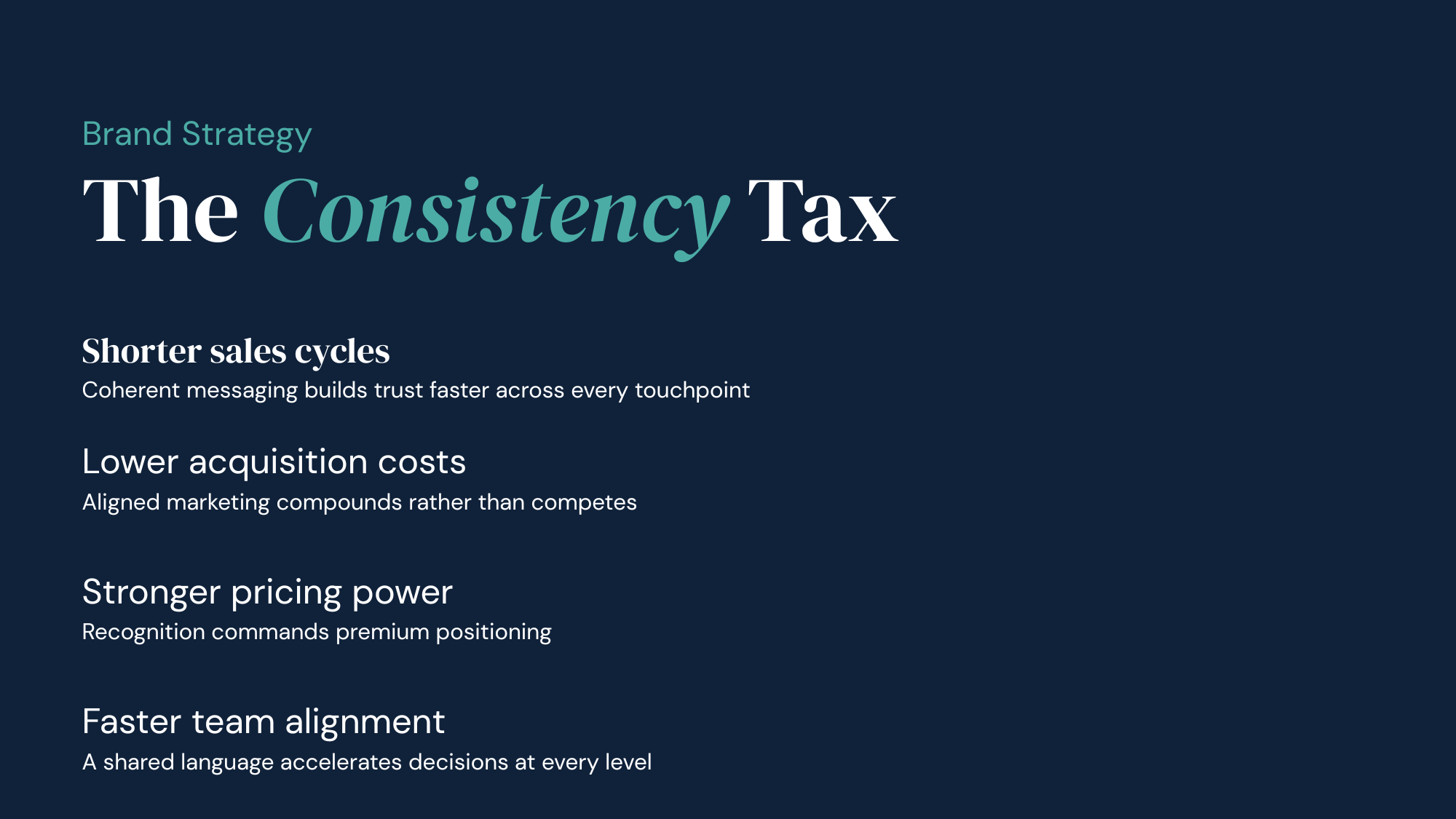
Longer sales cycles when prospects encounter conflicting messages across touchpoints.
Higher acquisition costs when marketing efforts pull in different directions.
Reduced pricing power when the brand doesn't command the recognition it should.
Slower team alignment when there's no shared language for what the business actually stands for.
These costs are real but diffuse. They don't appear as a line item. They show up as friction in every conversion, every negotiation, every internal debate about direction.
The way forward
Reducing the consistency tax doesn't necessarily require a rebrand. But does require treating brand as infrastructure rather than decoration. This is strategic process not a creative one.
That means moving beyond static guidelines to living frameworks that travel with the organisation as it grows. It means developing the clarity that allows teams to make consistent decisions without constant oversight. It means recognising that brand coherence is a leadership responsibility, not a marketing task.
The question isn't whether you can afford to invest in consistency.
It's whether you can afford to keep paying the tax.